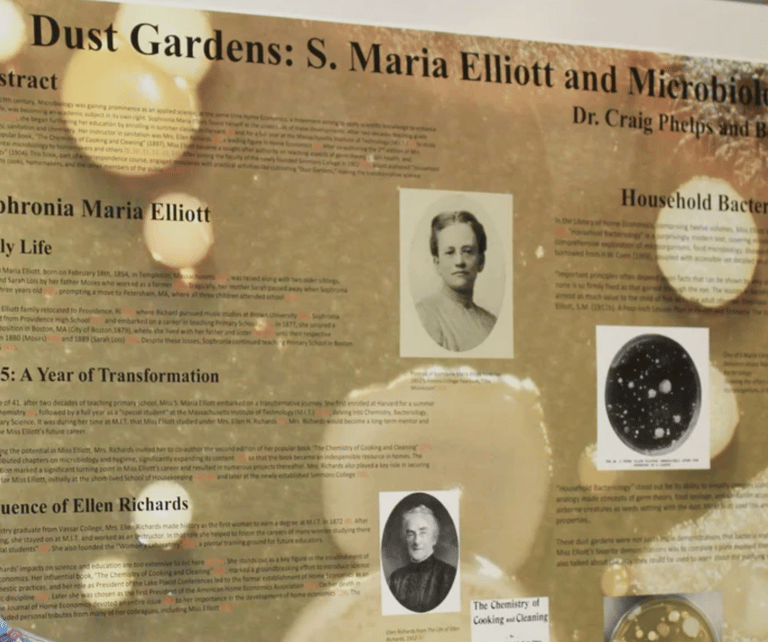
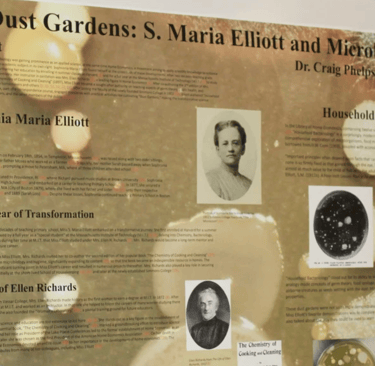
Dust Gardens: S. Maria Elliott and Microbiology Education in the Home Economics Movement
1. Poster Focus & Historical Context
This poster examines the role of Sophronia Maria Elliott in making microbiology accessible to the public through the early Home Economics movement. It focuses on her use of “dust gardens” as an educational tool to demonstrate germ theory, sanitation, and household hygiene during a time when women had limited access to formal scientific education. The project highlights how microbiology was applied to everyday life and how women educators helped bridge the gap between laboratory science and public health.
2. Research & Poster Development
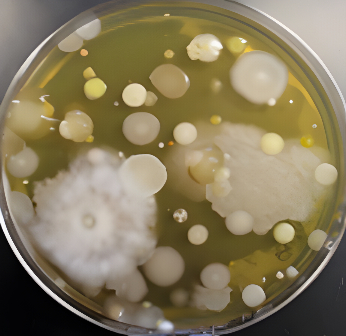
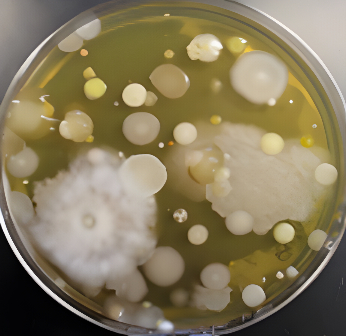
The project is based on archival and historical research, including primary sources, early microbiology texts, institutional records, and visual materials. The poster traces Elliott’s education under Ellen Richards, her academic career at Simmons College, and her influence through Household Bacteriology. Modern recreations of dust gardens were included to connect historical teaching methods with contemporary microbiology education, emphasizing experiential learning and science communication.
3. Presentation & Scholarly Engagement
This poster was presented at both Douglass Women’s College and the NEMPET 2024 Microbiology Conference, where it engaged academic audiences in discussions on women’s contributions to science, microbiology education, and public health communication. Presenting at a regional microbiology conference strengthened my ability to communicate interdisciplinary research, respond to scholarly questions, and situate historical science education within modern microbiology and healthcare contexts.